
Questions Concerning Technology
Recalling Heidegger to understand Yuk Hui

“The closer we come to the danger, the more brightly do the ways into the saving power begin to shine and the more questioning we become. For questioning is the piety of thought.” - Martin Heidegger, The Question Concerning Technology
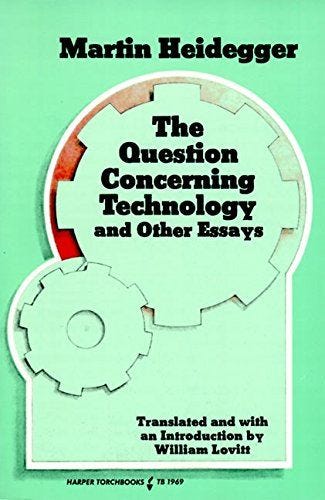
My purchase of Yuk Hui’s 2016 “essay,”1 The Question Concerning Technology in China,” may have been motivated by a bit of nostalgia. As I’ve mentioned before on this blog, as a college student I enrolled in a philosophy seminar where I encountered giant of German thought, Martin Heidegger. We read his book, The Question Concerning Technology and Other Essays, (translated and with an introduction by William Lovitt) which is now propped up in front of me. As the similarity in titles implies, Heidegger’s work looms large over Yuk Hui’s.
I’ll discuss Hui’s work below, but first, a bit more about my experience with Heidegger and the relevance of his thinking today.
Martin Heidegger’s writing is famously hard to grasp and even harder to absorb. Still, when I first encountered it, I found it oddly poetic—prose like none I’d ever read before. I remember feeling that the text was incredibly dense and mostly inscrutable, but also sometimes beautiful. Without fully understanding what Heidegger was saying (through his skilled translator), I felt I was at least getting the gist, and I think I must have wondered something like “could this rough river of language be hinting at something so deep as to be nearly ineffable in everyday English?”
I’ve long since learned that textual opacity frequently conceals nothing especially profound, often quite the opposite in academic writing; but even without fully understanding what the eminent philosopher was trying to communicate, I think my younger self could see that Martin Heidegger was not just using jargon to hide academic emptiness. He was clearly using everything he could from his German language to express a singular philosophical vision. He had something important to say about man’s relationship to technology in his time, and he was going to find a way to say it, even if he had to invent new words and concepts to do so.
I think most of my classmates gave up on Heidegger’s thick prose before coming to class on the day we discussed his essay, but enthralled by its uniqueness, the foreignness of the writing, I read to the end. Sure, I couldn’t explain what I had read any better than my classmates could, but I enjoyed the essay aesthetically and could kind of “feel the vibe,” of what he was getting at.
I was certain this wouldn’t pass muster in a college philosophy seminar until my professor actually affirmed my experience, telling me that I wasn’t alone in admiring Heidegger’s use of language as a kind of poetry. Apparently, many in the field shared my appreciation for Heidegger’s dense and inscrutable prose.2 With this comment coming as it did from a professor whose mind I imagined to be floating in a realm of worldly wisdom I might never access, I still recall how my spirits soared with the casually offered remark.
But sharing a single sentiment with a cadre of Heidegger scholars wouldn’t help me write my term paper (now long lost), and when I turned to the task I quickly discovered how difficult it is to characterize Heidegger’s thoughts in one’s own words. It’s still difficult, so for now I’ll just share a passage I highlighted in his book all those years ago:
The essence of technology is in a lofty sense ambiguous. Such ambiguity points to the mystery of all revealing, i.e., of truth. On the one hand, Enframing challenges forth into the frenziedness of ordering that blocks every view into the coming-to-pass of revealing and so radically endangers the relation to the essence of truth. On the other hand, Enframing comes to pass for its part in the granting that lets man endure—as yet unexperienced, but perhaps more experienced in the future—that he may be the one who is needed and used for the safekeeping of the coming of presence of truth. Thus does the arising of the saving power appear. The irresistibility of ordering and the restraint of the saving power draw past each other like the paths of two stars in the course of the heavens. But precisely this, their passing by, is the hidden side of their nearness. When we look into the ambiguous essence of technology, we behold the constellation, the stellar course of the mystery.
Clear as mud, right?
Okay, let’s do what an undergraduate in 2026 might do: use the technology at hand to translate this voice from another culture and time into something more legible here and now. I asked Perplexity AI, “What the heck is Heidegger saying here?” and received this translation:
Heidegger is saying technology is not mainly about gadgets; it is a way the world shows up to us, and that way is dangerous but not hopeless. He thinks modern technology tends to make everything seem like a resource to be ordered and used, yet that same danger can also reveal a possible path back to a deeper truth.
We should be very skeptical of this pithy gloss, but we must admit that the AI explanation of William Lovitt’s translation from the German comports with Arthur C. Clarke’s third law3 to feel like magic. After all, it was produced almost instantly by the kind of algorithmic alchemy that remains mysterious to most of us.
Though many AI tools claim to “think” as they process data, they’re in fact just generating responses by crunching probabilities over language patterns. As I discussed in a previous post, what they spit out is mostly just highly probably bullshit. And though a version of this is common among politicians, and probably all of us to some extent, I think most would agree that it’s a far cry from what should be considered actual thinking or genuine intelligence. It’s right there in the name: it’s “artificial”.
Heidegger explains in his essay that the traditional understanding of the “essence” of the artificial or technological, is two-fold. First, it is considered ‘a means to an ends’, and second, it is considered ‘a human activity’ (emphasis added). But in The Question Concerning Technology, Heidegger identifies a third essence of technology, calling it “a way of revealing.” What this means is that the instrumental use of technologies as human activity (technics) reshapes our relationship with the world. We take on the thinking that the technology demands and we begin to view reality through the prism of our tools. In Heidegger’s time, and even more so today, this has meant viewing virtually everything as a resource, as something to be exploited, as a means to an end. We see this everywhere and hear it in our language: “human resources”, “natural resources”, and even attention as a resource to be exploited in the “attention economy.” Everything comes to be understood as what Heidegger labels “standing-reserve” waiting to be used.
All the Heidegger commentary that trained the AI model so it could clearly summarize the passage I gave it fits into this category. It was created by various authors for various purposes, but the fate of this work was to feed a machine. The same is true of the data produced by most human interactions with LLMs: when we interact with LLMs we are literally doing data entry work under the guise of data extraction. Worse, when we engage in this kind of practice with computers, we are missing the opportunity to struggle with texts ourselves.
How much this matters to you depends on your outlook and purposes. In the realm of text interpretation, one could argue that LLMs just provide our era’s version of CliffsNotes, with computer engineers, data center workers, and internet content creators replacing the labor of writer, editors, publishers, distributors, and book store clerks. Like CliffsNotes, the AI summary provides what the consumer demands: a comprehensible summary of a text based on a consolidation of commentary. But it does so without any real human intelligence.
And unlike CliffsNotes, the LLM’s summary lacks the voice of a singular human interpreter. AI output is literally, generic: it is great at sounding intelligent by aping the rhetorical conventions of the genres it is trained on. But when asked to interpret a difficult passage of text, it misses the human quirkiness of a particular person wrestling with an author’s ideas in their own words.
If Heidegger were alive today, I think he’d be unimpressed. He’d likely perceive the advent of AI as revealing how far modern life has become organized around calculation, control, and instrumental reasoning. He’d accurately perceive that AI represents a state of affairs in which technological thinking has transformed “intelligence” itself into a commodity, ready to be packaged and sold, or more accurately, given up for the wizardry of mechanical pattern matching calculation.
It’s easy to see the allure of LLMs for students, but as any teacher worth his or her salt will tell you, wrestling with difficult texts is work that matters: it’s a practice that exercises one’s interpretative skills, which are life skills, and ultimately, skills for making meaning itself.
But we teachers also shouldn’t assume that our students aren’t smart enough to understand that AI can be as unhealthy for their developing minds and futures as data centers are for ecosystems. As recent news reports like the one below explain, several high profile graduation speakers have recently been booed when mentioning AI in their speeches:
In addition to “wrestling” with texts for understanding, it’s also important to appreciate great works of literature for their eloquence, and this is a job for which AI is uniquely ill-suited. Only humans can appreciate a text, because doing so must, by definition, be based on the individual aesthetic sensibilities that a human being has developed through experience. There is no accounting (or calculating) for taste!
When I first encountered Heidegger’s essay, it was the otherness of the writing (in translation) that attracted me more than his argument per se: the dense, foreign texture of his prose, and also his appeal to poetry itself, resonated with me and piqued my curiosity.
I had a very different experience with Yuk Hui’s book-length essay The Question Concerning Technology in China. It lacks any hint of Heidegger’s lyricism, yet it is no less ambitious. And at 312 dense pages, it’s a lot longer than Heidegger’s chapter-length essay.
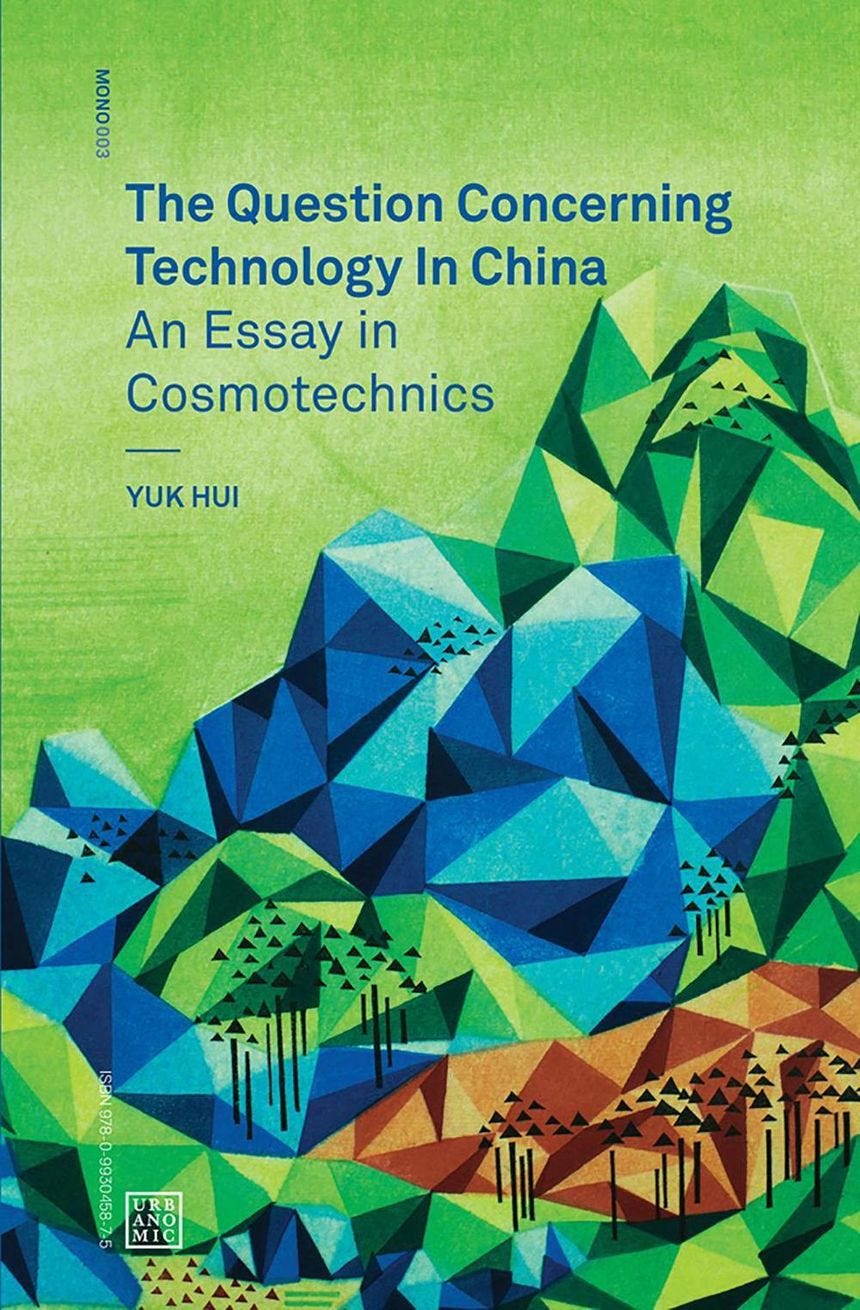
The book is written as a proper philosophical treatise: a long introduction followed by two main parts, each subdivided into sections marked with the § symbol (which is, I guess, standard for philosophical works).
Hui takes up Heidegger’s critique of modern technics4 and technological thinking, but pushes beyond it to argue for alternative models rooted in different cultural cosmologies—in this case, China’s. In the introduction, he writes: “I believe that there is an urgent need to envision and develop a philosophy of technology in China, for both historical and political reasons.” He targets Western philosophy of technology—largely springing from Heidegger—for implying that “there is only one kind of technics and technology . . . that they are anthropologically universal, that they have the same functions across cultures, and hence must be explained in the same terms.”
That’s a fair claim. And given how Western technocratic oligarchs are currently trying to impose the universalizing logic of their tools on humanity, Hui’s proposal of an alternative view feels hopeful. However, the essay was published in 2016, long before AI went mainstream. And thus, Hui’s book also reads partly as a tale of how Eastern philosophies of technology have failed to offer any significant alternative to the logic of optimization that now permeates digital technology, and—as philosophers such as Byung-chul Han point out—modern life in general. I imagine there is no shortage of burnout in China today either.
Summarizing the essay’s mission near the end of the introduction, Hui explains: “This book would like to offer another standpoint, using China as an example to describe the ‘other side’ of modernity, and hopefully providing some insights into the current programme of ‘overcoming modernity’ or ‘resetting modernity’ in the era of digitalisation and the Anthropocene.”
In the two parts following the introduction (which would be impossible for me to summarize succinctly), Hui offers a historical survey of major currents in Chinese thought, placing them in dialogue with the Western development of technics and with the material and conceptual importation of modern technology into China. The path he traces—from conceptualizations of Qi 器 and Dao 道 among various Daoist and Confucian thinkers to China’s encounters with modernity—is long, circuitous, and frankly, arduous. Though his writing is lucid, the density of ideas from East and West can be overwhelming at times.
To give you a sense of the scope, here is the “TIMELINE OF THINKERS, EAST AND WEST DISCUSSED IN THIS BOOK” that he provides on the three pages before the introduction:


In fact, this list is not at all exhaustive. In the introduction alone, Hui frames his thesis with the help of postmodern French theorist Michel Foucault, Sinologist Joseph Needham, and 13th Century Zen Buddhist monk, Dōgen.
Though The Question Concerning Technology in China was a lot to get through, feeling like a project at times, I’m ultimately glad I persisted to the end. My copy of the book is full of underlined passages and a dozen or so pages are flagged with sticky notes. Still, I don’t know that it left me with a clear vision of what Hui calls “Cosmotechnics” in China. But I sense that that might be okay. One goal of the book, achieved in my case, might just be for the tour through Chinese and Western thought to awaken readers to the idea that different cosmologies can exist. These might then offer alternatives to the techno-fascist reality within which we in “the West” increasingly find ourselves trapped. Hui does this by showing how technologies and technics always are, or always should be embedded within broader cosmological and moral orders.
Just today, the Pope in Rome issued an encyclical that seems5 to reaffirm this exact point, echoing Hui’s call for technics to be brought back to its rightful place within an ethical and cosmic order. If The Question Concerning Technology in China sought to open Western readers’ eyes to the possibility of alternative paradigms for relating to technology, perhaps it can be said that the West is finally beginning to wake up.
A 312 page essay in book form.
Not all were so charmed, though. The philosopher Rudolf Carnap famously used Heidegger as his prime example of philosophical nonsense, targeting the claim that “the Nothing itself nothings” (das Nichts nichtet) — arguing that “nothing” is a logical operator, not a thing that can act, and that sentences like this are not deep but simply meaningless. His 1932 paper is available here. Carnap wouldn’t have lasted long in a Zen monastary!
Hui defines this in an early footnote as “the general category of all forms of making and practice.”
Lapsed Catholic confession: I didn’t read the whole thing, and in fact after skimming it, I dropped the text into Notebook LM, made a few text queries, and then generated this impressive infographic. Have I sinned?
Dear Peter,
"The Question Concerning Technology" is more-or-less the only Heidegger that I've incorporated into my work... I found I had no desire to tackle his tomes, but this essay is exemplary. I return to it quite often, and it remains quite astonishing.
The Yuk Hui sounds fascinating, but I think pragmatically I shall settle for your notes on this book! 😊
Stay wonderful!
Chris.
Very nice piece. Thank you! Thinking about AI I am reminded of Leon Wieseltier's remark that "Every technology is used before it is completely understood. There is always a lag between an innovation and the apprehension of its consequences. We are living in that lag, and it is a right time to keep our heads and reflect.”
I think that's exactly where we are with a lot of modern technologies, not just AI We are living in the lag. And that is a disconcerting place to be.
But let me throw out a provocative thought about alternatives to the techno-fascist reality. Is it a coincidence that, in the West at least, it seems the only people who have adequately resisted this malaise have a strong and deeply-rooted sense of ethnocultural identity? I have in mind primarily the Amish, but also perhaps Orthodox Jews and similar groups. I don't think it's a coincidence. I think techno-fascism glides in easily to fill the void left by blood-and-soil and spiritual identities that are dissolved by modernity.