
Where is here?
The cross-cultural grammar and deeper meanings of experiences in nature

A few years ago, after about a 20-year hiatus, I rebooted my fly-fishing hobby. I’d enjoyed fishing in the U.S.—mostly in Connecticut and New Hampshire—when I was younger, but I was new to the pastime in Japan, where I’ve lived and worked for most of my adult life.
One day in June, I walked up the Ashikubo river, a nearby stream I’ve come to know pretty well. I was wearing running shoes, shorts, a t-shirt, and an old, multi-pocketed fishing vest I had bought used for 500 yen at a local bait and tackle shop.
The Ashikubo was then my favorite local stream. To get to where I liked to fish, I’d drive up a curvy country road that follows the river into the low foothills of Japan’s southern alps. The road runs close to river level near the downstream portion, past small farms and green tea fields, and rises five to ten meters above the stream in the upper stretches.
It was a warm cloudless day after several of near constant rain, and I parked at my usual spot—a narrow, grassy roadside pull-off next to a tea field overlooking the stream across from a big A-frame country home. Grabbing my gear, I climbed down a ladder that had been placed against a nearby concrete embankment. There was a tiny rocky riverside beach below, and there I assembled my rod and attached my reel before heading upstream.
Because of the recent rain there was a lot of water, so I stayed close to the right bank wherever I could. At several spots I had to climb over big rocks and boulders to move upstream while fending off tree branches and vines bulging forth from the thick riverside forest.
Most of the smaller rocks were wet and covered with moss in various shades of green. I had to concentrate to avoid slipping, but eventually, I came to a section of stream I’d never encountered before.
On past fishing trips I’d always stopped at this point in the river because the vegetation lining the stream was so thick. But today, for some reason, I decide to press forward, and before long I feel a change:
As I continue into this new section of stream, the white noise of the water takes over, and at some point, my mind goes completely quiet. I begin to feel a sense of euphoria, as if I’ve been given an opiate.
I have no idea why I’m feeling this way, but when I find a place to pause and look around, this is what I see:
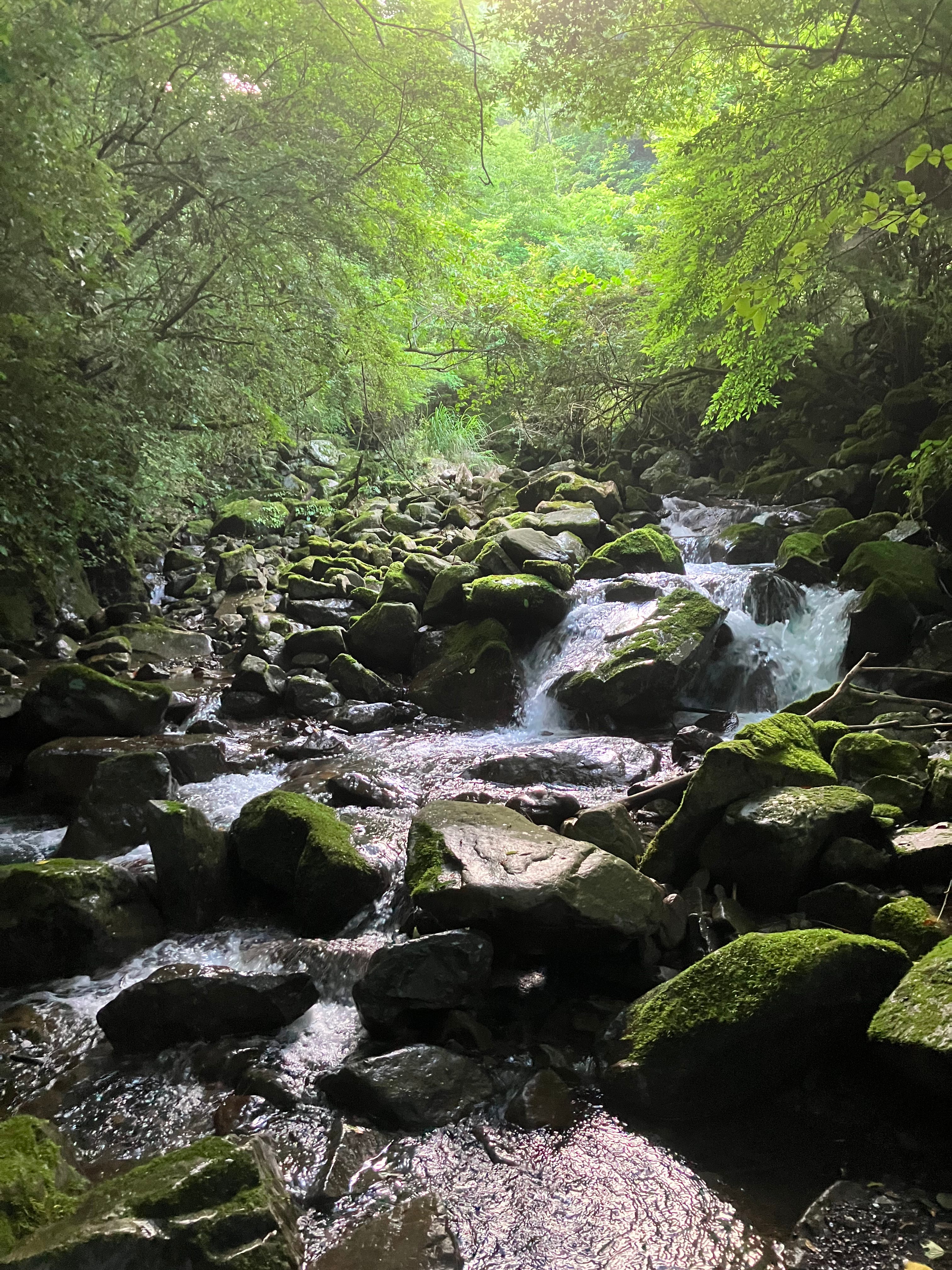
I had just recently traded in my flip phone for the cheapest possible iPhone, and eventually I think to pull it out of my fishing vest. I snap that picture and a few more, then put it away and just stand in the river for a while longer soaking in the scene.
I can’t remember how long this riverine bliss bath lasted—maybe five or ten minutes—but I can say for sure that it was something profoundly pleasurable, and totally unexpected. And in case you’re wondering, no, I had not just licked a psychotropic tree frog, swallowed a magic mushroom, or ingested any other illicit substance. Technically, I was stone cold sober.
I had just been putting one foot in front of the other, walking up a river, and before I knew it this uncanny feeling of elation had enveloped me.
How I felt and why I felt it was quite confusing, though at the time I didn’t really care. But what was this place? What was this feeling? What was happening?
Though I’ve had many wonderful experiences in nature, I can only remember another experience like this once before in my life, and it also involved lots of green and lots of water. It was in 2005 or 2006 during the time I was in grad school at University of Hawaii:
I’m surfing the reef break in front of Diamond Head on Oahu with my friend, Josh, and it’s begun to rain. It’s late afternoon, and the surf conditions have been pretty poor until that time so there aren’t many other surfers left in the water.
The air and water are warm and there’s still plenty of light left, but the thickening rain clouds above are shading the ocean dark green. At some point the rain gets heavier, but there’s virtually no wind, and the wave conditions seem to be improving. Visibility is down to only a few meters in any direction when smooth, green, head-high hills start to roll in all around us. The undulating ocean moves in its own organic rhythm and we’re part of it, rising and falling on the surface of a dark green carpet. The wave faces are glassy smooth except for dancing pock mark patterns left by the rain. The waves keep rolling in as perfect parabolas, and it’s easy to catch left-hander after left-hander. A few firm strokes are all that’s needed to get up and riding the green carpet. Stand, bottom turn, climb glassy face, carve a little, then slide off the lip for an effortless paddle back to do it all again.
At this point Josh has disappeared in the sea of green, as have the two or three other surfers I’d seen earlier. They could be nearby and I wouldn’t know it because of all the rising and falling water around me. But occasionally, I’d be waiting for a wave when Josh or one of the other surfers would break through the mist and zip by, riding that smooth green carpet.
I finally decide to catch my last left and ride it as far as I can before it’s nothing but whitewater. I drop to my stomach and ride the foamy froth over the final section of reef to the sandy shallows. Josh seems to have just arrived and is looking back out at the surf when I roll in:
“What was that?”
“I dunno . . . wild. Some kind green carpet world.”
“Wild . . . yeah, green carpet world.”
“Where Am I?” vs. “Where is here?”
Who knows what experiences like these mean. With no shared religious or cultural language at hand, I suppose it’s up to me to make sense of them myself somehow. That sounds like something an existentialist would say, so maybe put me in that bucket.
On the fishing trip that landed me the photograph above, I felt like I’d walked into another dimension filled with beauty and euphoria. During my green carpet world surf experience, it was as if a new dimension had descended upon me and the other surfers in the area. In both cases, it felt like there was no separation between self and scene.
One idea that has rattled around in my head since reading Heidegger in college is his notion of “thrownness.” It’s been almost 30 years, but I still remember the philosophy seminar where I encountered it. My professor mentioned “thrownness” during a class discussion about The Question Concerning Technology and Other Essays, which had been assigned. In fact, Heidegger never mentions the idea in that book, but my professor—a Heidegger scholar—brought it in up and explained it as a prelude to our class discussion. And somehow it just stuck with me all these years.
Thrownness is the idea that we all find ourselves “thrown” into a world we did not choose. We’ve been “thrown” into this existence—delivered “here” somehow—and in recognizing this state of affairs, questions arise: Where is here? Who are these people around me? What is this culture? This language? And of course, What does all this mean?
That first question, ‘where is here?’ sounds a bit awkward in English; it’s not a construction you’d normally formulate. When an English speaker finds himself lost somewhere it’d be much more natural to ask, “Where am I?”
Why do I mention this? Well, as it turns out, “Where is here?” is a pretty good direct translation of what a Japanese speaker might say: koko wa doko desu ka? (ここはどこですか). On one level, this is just an observation about differences in syntax, but a Japanese research paper (.pdf download) I read recently takes things a bit further1. The paper focuses on the fact that in Japanese syntax, the subject is often omitted and instead inferred by listeners or readers through context. When context is unknown or otherwise mysterious, you thus get this thought, or this utterance, “where is here?” From this perspective, what matters first and foremost in Japanese language and culture is context.2
But what’s any of this got to do with Heidegger’s German concept of “thrownness”? Or with my fishing and surfing experiences? Well, to me, that question of koko wa doko? or “where is here?” speaks to a universal human experience in nature, and it relates to (what I know of) Heidegger’s concept of thrownness. The realization of our “thrownness”—that by no choice of our own, we find ourselves thrust into a mysterious world of powerful forces—leads (some of) us to question and make sense of the world in our own way, with our own senses. We can find ourselves wide-eyed and enchanted, scared, bewildered, or—at times like these—just there, a part of some beautiful scene with no thoughts or questions at all.
Exploration of one’s environment is a primal and childlike activity. Here in Japan, depictions of such explorations have been aestheticized into a view towards nature that we can see depicted in landscape painting, Haiku, anime and many other art forms. In anime, for example, young characters are often shown exploring the natural world, walking along that enchanting line where fear recedes and gives way to wonder. This is common in the films of Miyazaki Hayao.
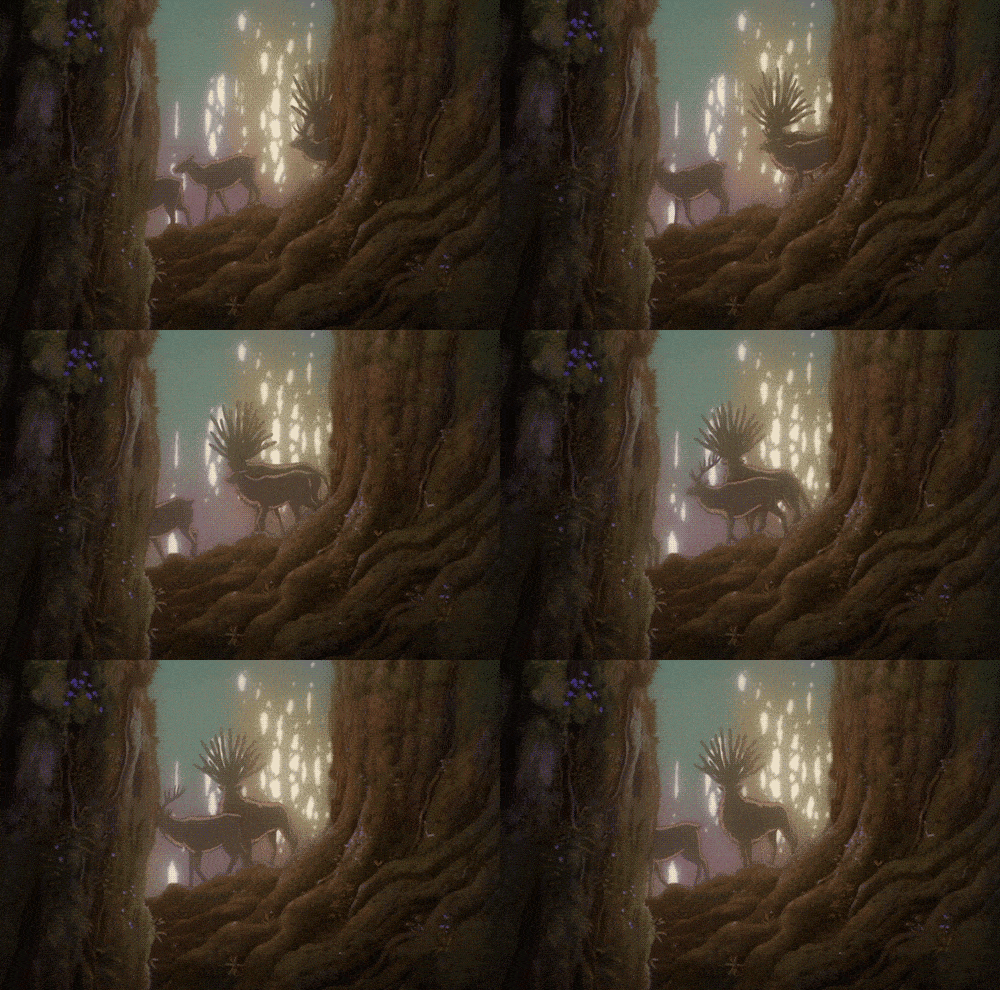
The inner world of the imagination and the outer world of nature seem to merge in these encounters, and we are fully present—neither inside nor outside of ourselves. We are in the present continuous with all of our senses activated.
It’s a kind of experience that’s very different from the mode of understanding we get from fables and other cultural and religious stories. Such stories are important because they pass down valuable lessons about the world. Scary stories of what can happen in a dark forest teach caution, so children don’t need to learn of nature’s indifference the hard way. But alone in nature, experiencing the world directly with all one’s senses, such stories easily fade away. That is, experiences in nature can allow us to let go of the meaning that other humans have made for us. We can listen instead to an inner voice of quiet intuition.
And so “where is here” is not about one’s “objective” position in a scene. It’s a wide-eyed childlike questioning of a vast and mysterious world that is perceived with all of the senses. It just points to a calm acceptance of the “suchness” of the natural world that appears before us. Whereas the ‘where am I’ question seeks to locate the self (“I”) according to the perspective of some real or imagined outside observer, the ‘where is here’ question is about making sense of place.
The self is so small in comparison to the natural world that it is easily forgotten in this process of wide-eyed discovery, and we are transported back to the childhood of our lives and the primal childhood of our species, before conceptual language distinguished our individuality.
Is this worldview quintessentially Japanese? No, I think it’s primal and universal, but I do think that Japanese artistic traditions have refined an aesthetic around the sensation of wonder that comes from deep experiences in the natural world. And though this worldview can be connected to Shinto and Buddhist ideas, I would argue that it’s a view towards nature that doesn’t need to be filtered through theological lenses to be significant. There is no hero in these experiences because there is no real story. It’s just the experience of place in nature.
I don’t mean to disparage religious worldviews or the meaning with which they infuse the world for some people. I only mean to say that filtering my experiences with nature through such a lens is no longer possible. I’m not sure it ever was. For me, being in nature is humbling enough.
And, again, with the “where is here?” question, I’m not trying to essentialize some exotic Japanese way of seeing or being in the world. Far from it. I’m just trying to make sense of what I experienced in that local stream and in the shifting green water world of the Pacific Ocean. I am thinking through one (Pacific) language and culture at hand to describe my experience now, in hindsight, whereas at the time there were almost no words at all. And—trite as it sounds, I’ll say it: in these experiences there was no “I.” There was just a kind of magical and bewildered feeling of ‘What is this?’ “Where is here?”
Home is in the Heart is in the Body is in Nature
Neither of the two places where I experienced the natural world so profoundly could be called my home. But in both places I was at home in my body and mind in nature, which may be as close to “home” as any of us can get. I knew my surroundings enough to forget myself. “I” was lost in experience, in relation, in nature.
In our age of specialization, natural scientists explain the physical realm, psychologists parse our various mind and brain states, and theologians and priests are designated to deal with religious experience of the soul. In explaining what happened to me in that forest stream and on coast of Oahu, a psychologist might allude to the release of serotonin or dopamine precipitating my ensuing “flow states,” whereas a religious leader might reference transcendence or God’s creation. The new-agers would mix and match language from science and religion and anything else that fits to make sense explain these experiences in other ways.
I’ll just call what I experienced ‘non-thinking’ because the most salient feature for me on these two occasions, surrounded by green, was a complete pause in mental chatter. These were direct experience of nature without any extraneous mind noise. There was no fear and no anticipation. No algorithmic if-then thinking. No “if I just do this, then I can get this or be safe from that.” There was no thinking at all, and there was no swirl of emotion except for the high feeling of being above that kind of thinking and away from fear and anticipation. But also completely present.
Actually, I know I’ve experienced times like these before, but they just aren’t so vividly impressed in my memory (or my phone’s camera roll). In fact, moments like these may be why we pursue activities like surfing, fly-fishing, and photography in the first place. Most of the time we spend in relation to hobbies like these involves mundane preparations, travel, and waiting. But it’s these brief moments of non-thinking that keep us coming back.
When we are young, before there’s a lot of language in our heads, it’s not hard to slip into that blissful state of presence. But once we’ve been programmed by family, friends, and society to hold on to certain values and fear certain types of people, animals, events, machines, and failures, this becomes much more difficult.
Society fills our minds with language and images, and most of all, stories. We absorb the fears and anxieties of the people who live around us. We take on stories of the past and future, and we come to think that every action today will have a consequence at some later time, good or bad, fitting into some kind of narrative arc based upon the archetypes our minds have inherited. This realization inevitably produces anxiety that, as adults, we manage in various ways.
Being in nature is a healthy way to temporarily escape these anxieties of everyday life, but we all know people who escape in other, less healthy ways. Activities like surfing and fishing are pleasurable because they are oriented towards a single goal (catching waves or fish), but within a process that is itself enjoyable. Photography, and many other activities are like this, too.
Fear and Sense-making / Thinking and Non-Thinking
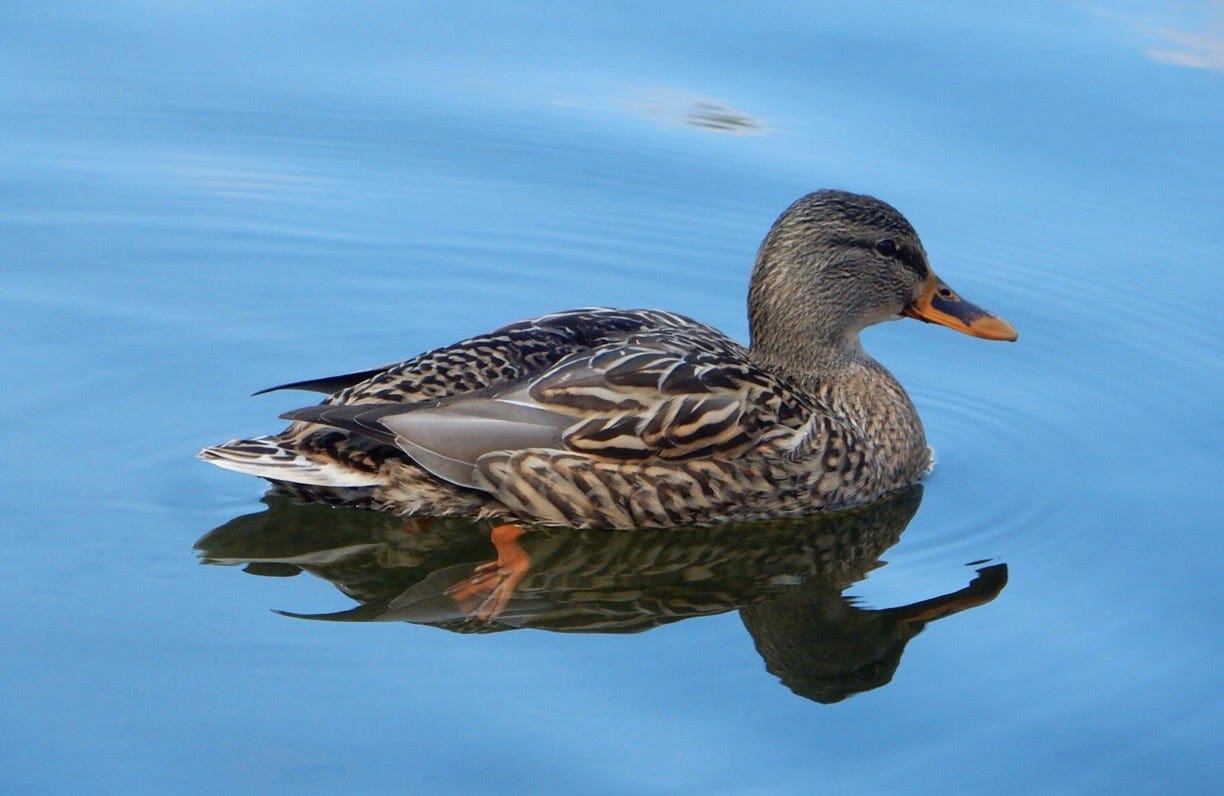
This is another lucky shot. I took it at a pond near my house (this one with a camera camera, not a phone). The duck appears peaceful, but also vigilant: looking at the duck’s eye we know that if a golden retriever were to suddenly bound into the pond, the bird would be off in a flurry of splashing water and flapping feathers.
If, when surfing that day in Hawaii, I’d seen a tiger shark suddenly appear under the wavy green carpet (not an entirely uncommon occurrence), I’d be panic-stricken as well. My hippy-dippy mystical flow-state surf experience would be over in an instant and I’d be paddling for my life just like that duck. If I escaped, I’d be telling a very different story!
Fortunately, this never happened. During my two years in Hawaii, I heard other surfers’ stories of shark sightings, but I never encountered one myself. Because of those stories, the specter of those mysterious beasts always had a place in the back of my mind when I was out on the ocean, but the stories never stopped me from getting out on the water.
Which is not to say that my life was anxiety free. Was I making a good impression on my professors at the university? With the other grad students? Where did I fit in the social hierarchy? Would I be able to get a job when I graduated? What in the world would I do?
Most of us don’t have to escape from apex predators very often, but social questions like these shape the anxieties that fill our lives. Electronic social networks seem to make this anxiety worse as we all catch little glimpses into the digital projections displayed by other humans we know and those we don’t.
But the digital worlds where we lurk are not real worlds. They are simulacra. We post and view photos, videos, stories, essays like this one, and scroll through millions of random peoples’ thoughts, but what we are seeing and reading are all just projections of reality, not reality itself.
These digital media can enchant and entertain, but they are always a step removed from real-world experience. We can get meaning from other people’s stories, and we can make meaning of our own experiences in various ways (like this) through digital media, but nothing can replace that quiet, blissful bewilderment we get from being in nature.
Note: A revised and polished version of this post has now been published in the online ecolinguistics journal, Language & Ecology. Please visit that journal’s website for more writing in this spirit (and some more “academic” work as well).
Coda:
A few months after my euphoric fishing experience on the Ashikubo, the region was pummeled by torrential rain for several days. Many sections of asphalt on the riverside road I once travelled were dislodged and washed away, and other large sections of road were buried under landslides. My favorite fishing spot thus became inaccessible by road, and too treacherous to reach any other way.
A year later, the situation hadn’t improved much, but when I visited the river again this past spring, I found the road has been rerouted in several places and repaired in others, making it passable again. The river, however, has been completely transformed. The place where the picture above was taken is now unrecognizably. In fact, I can’t locate it: the general area where that section of stream once ran is now just a wide field of bald rocks, boulders, and other forest debris. Most of the trees and other vegetation are gone—having been uprooted and swept away by the raging waters of torrential rains.
I’ve continued to surf in Japan, and a few times back in Hawaii since my time living there. Each trip brings its own kind of adventure and the ineffable pleasure of rising and falling with the soothing pulse of the Pacific, but I’ve never had another surf experience that compares to that magical day on an undulating green carpet in front of Diamond Head.
Interestingly, the hint that led me to this paper was a student’s comment in a class I teach on cross-cultural communication. One of her other professors had lectured about this grammatical difference and its connection to culture. It was only recently that I recalled this student’s comment and went looking for the research it was based upon.
A frequently cited study on culture and point of view from 2003 explores some differences between East Asian and Western styles of perception empirically through several interesting experiments. The article contains several interesting visual perception tasks which you can try out if you are interested (including the famous cow-chicken-grass riddle)..